Today is
Shrove Tuesday (also known as
Mardi Gras), the last day of
Carnival, a Western Christian festive season that occurs before the liturgical season of
Lent.
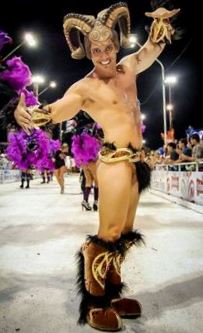
Carnivalesque/Shrovetide events typically take place during February or early March. In a number of places around the world, members of the LGBTQI community have become a visible part of Carnival, imbuing these annual celebrations with a unique perspective and a deeper meaning that harkens back to Carnival’s indigenous European (i.e., pagan) roots and thus an emphasis on renewal through transgression and upendment. (Halloween, it should be noted, has similarly been
reclaimed by queer folk.)
Carnival typically involves public celebrations, including parades, street parties and other entertainments, some of which combine some elements of a circus. Elaborate costumes and masks allow people to set aside their everyday individuality and experience a heightened sense of social unity. Participants often indulge in excessive consumption of alcohol, meat, and other foods that will be forgone during upcoming Lent.
The characteristics of the celebration of Carnival take their origins from ancient European festivals, such as the Greek
Dionysian (the
Anthesteria) or the Roman
Saturnalia. During these festivities, there was a temporary release from social obligations and hierarchies to make way for the overthrow of order, joking and even debauchery. From a historical and religious point of view, the Carnival therefore represented a period of celebration, but above all of symbolic renewal, during which chaos replaced the established order, which, however, once the festive period was over, re-emerged new or renewed and guaranteed for a cycle valid until the beginning of the following Carnival.
From an anthropological point of view, Carnival is a reversal ritual, in which social roles are reversed and norms about desired behavior are suspended. During antiquity, winter was thought of as the reign of the winter spirits; these needed to be driven out in order for summer to return. Carnival can thus be regarded as a rite of passage from darkness to light, from winter to summer: a fertility celebration, the first spring festival of the new year.
The following explores the queer dimension of Carnival and is excerpted from
Cassell's Encyclopedia of Queer Myth, Symbol and Spirit by Randy P. Conner, David Hatfield Sparks and Mariya Sparks.
________________________
A. Orloff writes of Carnival, “Nothing can resist this tidal wave of juggernauting chaos as it turns our ordered world on its head. . . . [T]his is a magical time outside of time in which one and all are changed, everything is reversed, inverted. . . . Through orgiastic excess and folly, through the embrace of the opposite within us, through the baptism of frenzied chaos we are reborn”
The association of homoerticism and transgenderism with the carnivalesque is an ancient one. In late antiquity, Christian authorities commenced their attempt to control or abolish carnivals, which they correctly perceived as celebrations of the exiled gods. “The remains of heathen superstitions of all kinds are forbidden,” the
Quinisext (or Trullan) Synod found it necessary to declare almost seven hundred years after the triump of Christianity: “the festivals of the Kalendar, the
Bota (in honor of
Pan [left]), the
Brumalia (in honor of
Bacchus), the assemblies on the first of March, public dances of women, clothing of men like women, and inversely, putting on comic, satyric, or tragic masks, the invocation of Bucchus at the winepress, etc. . . . [A]ll these activities are forbidden.”
Despite these efforts to destroy Carnival, however, the phenomenon, including its expression of transgenderism through transvestism, persisted. Indeed, in many sectors during the Middle Ages, Carnival was quietly acknowledged as a necessary release of pagan expression in a Christianized world. In the words of
Mikhail Bakhtin, “the carnival processions . . . were interpreted as the march of the [officially] rejected pagan gods.”
See also the following related posts at The Leveret’s brother site, The Wild Reed:
• The Pagan Roots of All Saints Day
• The God from the House of Bread: A Bridge Between Christianity and Paganism
• Pagan Thoughts at Hallowtide
• Recaiming the “Hour of God”
• Celebrating the Coming of the Sun and the Son
• Advent: A “ChristoPagan” Perspective
• Beltane and the Reclaiming of Spirit
• Thomas Moore on the Circling of Nature as the Best Way to Find Our Substance
• Gabriel Fauré’s “ChristoPagan” Requiem
• Biophilia, the God Pan, and a Baboon Named Scott
• The Piper at the Gates of Dawn
• The Devil We (Think We) Know
• Cernunnos
• Beloved and Antlered
• Integrating Cernunnos, “Archetype of Sensuality and the Instinctual World”
• A Day to Celebrate the Survival of the Old Ways
• The Prayer Tree
Images: Subjects and photographers unknown.