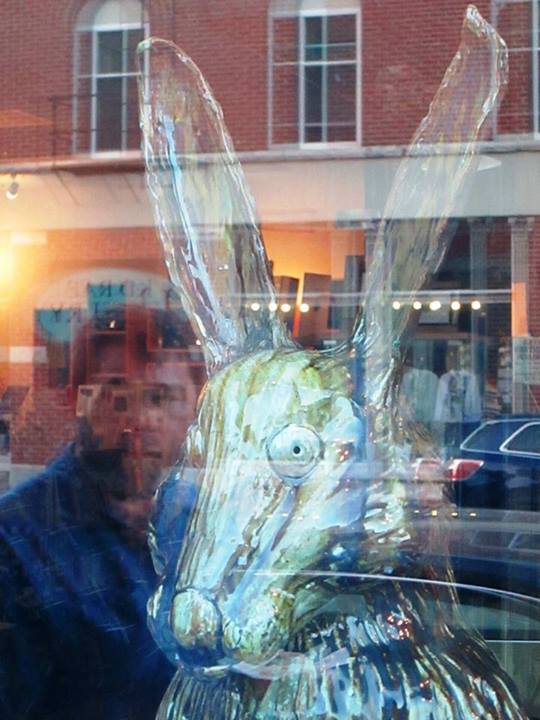
Writes Simon Carnell inHare(2010) . . . Most of the salient characteristics of hares can be usefully presented in the way they differ from rabbits. Hares are generally much larger: longer and leggier, giving an impression of stature enhanced by their generally much longer ears. They reach weights of five kilograms in the far north, averaging three in temperate zones (with some exceptions) and two at the equator, frequently occupying a unique position as the only animals of their weight in a given environment. The brown hare is about the size of a domestic cat. Rabbits are gregarious with relatively complex family groups; hares mostly solitary with minimal pair bonding among promiscuous adults and relatively little parental care of their young. The relatively complex coat colour of hares, including seasonal changes, is linked to their reliance upon camouflage as well as speed. Their speed, camouflage, lack of family life and even size are linked as adaptations to their principal behavioural difference from the rabbit, namely, the fact that they do not burrow.
Writes Terry Sanderson inThe Gay Man's Kama Sutra: Our goal is happiness, and if we live life nobly, with the good of others always in our hearts, happiness will surely follow. And if we do this, as well as always striving to appreciate the best things in life, we will attain happiness not only for ourselves but for others, too. It becomes a self-perpetuating cycle, a wonderful wheel of life. We must place the act of sexual congress in this context, too, for love is a sure and essential route to happiness. The fusion of our body with that of another is a perfect ecstasy that takes happiness to another sphere and transforms it, like magic, into bliss. Lovemaking that is mindful of the needs of your lover, as well as your own desires, is lovemaking that feeds the soul and nourishes the spirit.
Sex has psychological aspects. Entering the altered state of consciousness with another person opens us to him and him to us. Sharing orgasms with another person stirs feelings of connection and intimacy. It opens us to his "karmic patterns" (which is why we should exercise caution about whom we get involved with). It deepens true love when that is present. It boosts our self-image and raises our energy level. Being in love and full of sexual vibrancy makes us feel good. Even without the emotions of "true love," having a satisfying sexual connection with another man makes us feel alive. Having sex that feels good and makes us self-assured and confident in our worth as a person and as an attractive human body changes our behavior. We can be kind and loving, happy and generous, sharing our joy with other people. "Everybody loves a lover" says the old song lyric. When we seek spiritual answers as gay people, we are necessarily looking for sex-positive and gay-positive answers. This puts us in a special place in the evolution of religion. The experience of attraction to another man (or, for a lesbian, to another woman) is a source of joy for the beauty of life itself.
In the following excerpt fromHare, Simon Carnell explores the hare's role in the persecution of witchcraft in England in the sixteenth and seventeenth centuries. Naturalistic explanations include the fact that [the hare] is nocturnal, solitary, somewhat mysterious, popularly (and learnedly) believed to be lascivious; sometimes seen in 'parliaments' or sitting in coven-like circles with other hares. It has been suggested that, like the cat, the hare is singled out as a 'human-in-disguise' because it 'usurps the right to state.' By assuming its form, witches were probably also thought to be usurping some of the positive associations the animal had acquired as a symbol in Christianity, stolen away and inverted. . . . Or rather, stolen back, since in northern Europe, at any rate, Christianity tapped into the power the hare derived from Celtic and British paganism. According toDiothe ancient Britons not only tabooed hare flesh (a sure sign of a sacred function) but used hares for the purpose of divination.Boudiccais said by him to have released a live hare on the field of battle for some such purpose.
"Like a hare, springing erect and bounding exuberantly across a dew-kissed field, the beauty and energy of the aroused male embodies the burgeoning life force often associated with spring. After all, the hare is symbolic of natural phenomena that connote actions of the aroused male: the rising sun, the coming spring. In folklore, art and dreams, hares herald great bursts of energy and creativity. They are often thought to be touched by divine madness, by a spirit of anarchy that overturns dogmatic tradition and restrictions. They are tricksters, offering us new ways of seeing and being in the world. They are emblems of the integration of body and soul."
"In many mythic traditions, [hares] were archetypal symbols of femininity, associated with the lunar cycle, fertility, longevity, and rebirth. But if we dig a little deeper into their stories we find that they are also contradictory, paradoxical creatures: symbols of both cleverness and foolishness, of femininity and androgyny, of cowardice and courage, of rampant sexuality and virginal purity. In some lands, Hare is the messenger of the Great Goddess, moving by moonlight between the human world and the realm of the gods; in other lands he is a god himself, wily deceiver and sacred world creator rolled into one."
"The [medieval] bestiarists [those who named and attributed human characteristics to animals] deemed the hare’s sex to be ambiguous, and its mode of reproduction strange. They included the hare in a group of several beasts that they asserted had been declared unclean in the Mosaic law because of their alleged sexual deviance . . . Moses Azikri (1533-1600) wrote that one who is involved in homosexual relations is reincarnated as a hare."
– Marc Michael Epstein Dreams of Subversion in Medieval Jewish Art and Literature
NOTE: I've had reports of readers not being able to access this blog and/or pages of it because they get stuck on the “Sensitive Content” warning page which redirects back to itself every time they try to click through. I'm not sure what the issue is, though it might be a problem stemming from when the site shifted from http to https. Accordingly, it should be resolved when you add https:// to the front of the link for the page you are trying to access.