Showing posts with label Folklore. Show all posts

Tuesday, February 21, 2023

Carnival

Today is Shrove Tuesday (also known as Mardi Gras), the last day of Carnival, a Western Christian festive season that occurs before the liturgical season of Lent.

Carnivalesque/Shrovetide events typically take place during February or early March. In a number of places around the world, members of the LGBTQI community have become a visible part of Carnival, imbuing these annual celebrations with a unique perspective and a deeper meaning that harkens back to Carnival’s indigenous European (i.e., pagan) roots and thus an emphasis on renewal through transgression and upendment. (Halloween, it should be noted, has similarly been reclaimed by queer folk.)

Carnival typically involves public celebrations, including parades, street parties and other entertainments, some of which combine some elements of a circus. Elaborate costumes and masks allow people to set aside their everyday individuality and experience a heightened sense of social unity. Participants often indulge in excessive consumption of alcohol, meat, and other foods that will be forgone during upcoming Lent.

The characteristics of the celebration of Carnival take their origins from ancient European festivals, such as the Greek Dionysian (the Anthesteria) or the Roman Saturnalia. During these festivities, there was a temporary release from social obligations and hierarchies to make way for the overthrow of order, joking and even debauchery. From a historical and religious point of view, the Carnival therefore represented a period of celebration, but above all of symbolic renewal, during which chaos replaced the established order, which, however, once the festive period was over, re-emerged new or renewed and guaranteed for a cycle valid until the beginning of the following Carnival.

From an anthropological point of view, Carnival is a reversal ritual, in which social roles are reversed and norms about desired behavior are suspended. During antiquity, winter was thought of as the reign of the winter spirits; these needed to be driven out in order for summer to return. Carnival can thus be regarded as a rite of passage from darkness to light, from winter to summer: a fertility celebration, the first spring festival of the new year.

The following explores the queer dimension of Carnival and is excerpted from Cassell's Encyclopedia of Queer Myth, Symbol and Spirit by Randy P. Conner, David Hatfield Sparks and Mariya Sparks.

________________________

A. Orloff writes of Carnival, “Nothing can resist this tidal wave of juggernauting chaos as it turns our ordered world on its head. . . . [T]his is a magical time outside of time in which one and all are changed, everything is reversed, inverted. . . . Through orgiastic excess and folly, through the embrace of the opposite within us, through the baptism of frenzied chaos we are reborn”
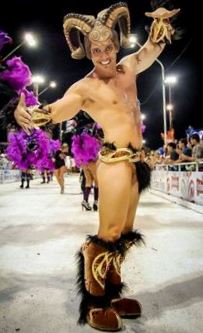
The association of homoerticism and transgenderism with the carnivalesque is an ancient one. In late antiquity, Christian authorities commenced their attempt to control or abolish carnivals, which they correctly perceived as celebrations of the exiled gods. “The remains of heathen superstitions of all kinds are forbidden,” the Quinisext (or Trullan) Synod found it necessary to declare almost seven hundred years after the triump of Christianity: “the festivals of the Kalendar, the Bota (in honor of Pan [left]), the Brumalia (in honor of Bacchus), the assemblies on the first of March, public dances of women, clothing of men like women, and inversely, putting on comic, satyric, or tragic masks, the invocation of Bucchus at the winepress, etc. . . . [A]ll these activities are forbidden.”

Despite these efforts to destroy Carnival, however, the phenomenon, including its expression of transgenderism through transvestism, persisted. Indeed, in many sectors during the Middle Ages, Carnival was quietly acknowledged as a necessary release of pagan expression in a Christianized world. In the words of Mikhail Bakhtin, “the carnival processions . . . were interpreted as the march of the [officially] rejected pagan gods.”


See also the following related posts at The Leveret’s brother site, The Wild Reed:
The Pagan Roots of All Saints Day
The God from the House of Bread: A Bridge Between Christianity and Paganism
Pagan Thoughts at Hallowtide
Recaiming the “Hour of God”
Celebrating the Coming of the Sun and the Son
Advent: A “ChristoPagan” Perspective
Beltane and the Reclaiming of Spirit
Thomas Moore on the Circling of Nature as the Best Way to Find Our Substance
Gabriel Fauré’s “ChristoPagan” Requiem
Biophilia, the God Pan, and a Baboon Named Scott
The Piper at the Gates of Dawn
The Devil We (Think We) Know
Cernunnos
Beloved and Antlered
Integrating Cernunnos, “Archetype of Sensuality and the Instinctual World”
A Day to Celebrate the Survival of the Old Ways
The Prayer Tree

Images: Subjects and photographers unknown.

Tuesday, February 7, 2023

A Mystery No More

Dr Pirrello et al. state: “Lagophthalmos derives from the Greek terms λαγος (hare) and οφταλμος (eye). It is a condition in which the eyelids are unable to close the palpebral aperture completely and cover the whole eye. Hares in fact sleep with their eyes open.” This statement requires some etymologic remarks.

The belief that hares sleep with their eyes open can be found in the literature ever since the ancient Greek and Roman societies. For a long time the hare’s habits were hardly known. The hare was a mysterious creature and became the subject to much folklore. Nowadays, however, many of the mysteries about the hare are disproved as we are now better able to observe hares with our modern filming techniques. We now know that hares are able to close their eyes and that they do not sleep with their eyes open.

Source

See also the previous posts:
Golden-Coloured Eyes
Amber Eyes

Images: Photographers unknown.

Wednesday, February 1, 2023

The Promise of Imbolc


Writes Carl Neal in Imbolc: Rituals, Recipes, and Lore for Brigid’s Day:

When the dark days of winter seem to have gone on forever, the first sign of spring refreshes our souls. It is a promise that winter will not last forever and that warm and fertile days will come again soon. Even through snow, the daffodils will push their heads up with a startling flash of green and yellow against the otherwise unbroken glare of winter’s white. While you can still see your breath like steam in the chilled air, the first taste of fresh milk means that new life will soon be born. Weary from winter’s dark, it also means that the soul will soon be reborn in the growing warmth of the sun. There yet may be snow on the ground but there are new plants sprouting just beneath that protective layer. As bears awaken from their winter slumber, so too does the earth, and life everything reawakens.

Also known as “Imblolg,” “Oimelc,” and the “Feast of St. Brigid,” Imbolc is the sabbat midway between the winter solstice and the vernal equinox. Imbolc is celebrated on February 1 and precedes the more recent Christian reinterpretation of Imbolc called “Candlemas” which is celebrated on February 2. Although you might often see the terms Imbolc and Candlemas used interchangeably, they are actually different holidays. Imbolc is the time when life begins to awaken from its winter sleep and prepare for the warmth and longer days that are soon to start. During the depths of winter, it can feel as though the warm sun and soft breezes of spring will never return and the cold might go on forever. Imbolc marks the turning point when life eagerly begins to look forward to the increasingly warmer days.

Imbolc is a time when new plans are made and new ideas are “planted.” It is also traditionally a time to examine the people, objects, and philosophies in our lives. It is an opportunity to discard the things we don’t need or that are holding us back. It is when we make new plans and improve old ones. In a sense, the Imbolc part of the Wheel of the Year is a winter cocoon. Upon emerging, we may be greatly changed indeed from the beings who celebrated Yule only weeks before.


Image: “Imbolc Hare” by Wendy Andrew.

See also the previous posts:
Sacred
Let the Spiral Turn and Turn
Sol Invictus

And at The Leveret's brother site The Wild Reed, see:
Imbolc: Celebrating the Freshness of New Beginnings
Imbolc: Festival of Light
Taking the High Road . . . in Imbolc’s Time of Growing Light and Emerging New Life

Sunday, January 22, 2023

2023 – Year of the Hare

This year the Chinese New Year is celebrated between Sunday, January 22 and February 5. Many will start the celebration on Saturday night.

If you look at the full moon, the dark areas outline a hare’s ears, body, and paws. In Chinese folklore, this hare lives in the moon so that all on earth can see her at work. The Chinese word Tu-tz (兔子) can mean either hare or rabbit.

Two thousand years ago, Chinese art portrayed a rabbit in the moon holding a pestle with which to grind cassia-tree twigs, cinnamon or immortal herbs to give to Chang-e, the beautiful moon goddess or to other gods and goddesses. Sometimes, the scene depicts a hare, which is bigger and has longer ears, hind legs, and whiskers than an ordinary rabbit (but the Chinese translation is the same). Often, the hare faces Change-e, the moon goddess. Usually, the rabbit is said to be the color white, but In medieval Chinese literature the rabbit is also called the Jade Rabbit and sometimes the Gold Rabbit.

The zodiac year is like three wheels going around to coincide animals, elements, and colors. This year, the Hare coincides with Water in the cycle of elements, which is also associated with Black; so, fortune-tellers will forecast the future according to the qualities of the Water or Black Hare.

The hare is often seen as a symbol for longevity, upward mobility, and a peaceful life.

Source

Related Off-site Link:
Welcome to 2023 (Finally)! – Astro Gallus (January 22, 2023).

See also the previous posts:
The Chinese Year of the Hare (2011)
Sign for the East
Qualities of People Born in the Year of the Hare

Image: Artist unknown.

Monday, August 1, 2022

Day of the Male Dryads


Invocation to the Dryads

Hail, Keeper of the Trees!
Hail, Spirits of the Old Ones!
Sinewy strong male beings,
Seductive to those of us
We men who love men.

You who are the living breath of the forest,
You who are the living soul of the wood,
You who raise your arms to the wind,
You who are stripped nude by the autumn
And grow full rainment again in spring,
We honour you today, not merely with words,
But with deeds; we will work the earth
And plant more of you than we cut down.

You give us warmth in winter, and heat for cooking food,
And fruit, and nuts, and most important,
The very air we breathe.
We lust after you for your many gifts,
Handsome ones who cast their spells.

Hail, male dryads of the forest!
We give you honour on this day.


Related Off-site Link:
Lughnasa: How to Celebrate the Ancient Celtic Festival – Michael Gilligan (Irish Central, August 1, 2022).

See also the previous posts:
Harvest Blessings
A Calendar of Hares

Image 1: Lokiween.
Image 2: Photographer unknown.

Wednesday, August 12, 2020

Familiar

Few animals can have been given as many different names as the hare. Some are very localised and often the hare's alternative names are associated with cats. This is thought to be because both cats and hares have been linked with witches, as their familiars.

– Jill Mason
Excerpted from The Hare
p. 131

See also the previous posts:
Creature of Mystery, Creature of Magic
Usurper
The Hare-Witch
Hallowtide Transformations

Image:Hare Familiar Nature Spirit” A5 notebook by Arabella Figg. Part of the company's “Ethereal Familiars” collection.

Saturday, August 1, 2020

Lammastide


Hoof and horn, hoof and horn,
all that dies shall be reborn


Lammastide — Lughnasadh — First Harvest.

Originally a festival celebrated by the Celts and Saxons, this day marks the first of three harvests in the annual solar cycle.

It is a festival of Light and Fire. We celebrate today by baking breads, crafting with our hands and pausing to give thanks to God – the One, the All – for the bounty we are receiving in our lives, particularly the bounty of this year.

This is a holiday to evaluate and release. We’re encouraged to reflect on what has grown throughout the year, what has not, and what we can still potentially gather in the coming months ahead.

Love and Light!


Corn and grain, corn and grain,
all that falls shall rise again


Related Off-site Links:
Lughnasadh Blessings – Arianna Alexsandra Collins (Hearken to Avalon, July 28, 2017).
Lughnasadh and Lammas – Celestite (A Pagan Tapestry, July 31, 2010).

See also the previous post:
Harvest Blessings

Image 1: Artist unknown.
Image 2: Wendy Andrews.
Image 3: Artist unknown.

Saturday, April 11, 2020

The Original Easter “Bunny”


The following is excerpted from "The Hare Is the Original Easter 'Bunny'" by Stephen Colton (The Irish Times, March 26, 2016).


In cultures throughout the world, from America to the Far East, Africa to Europe, the hare is embedded in the folk myths of our ancestors. It is associated with the moon, the dawn, fertility, death, resurrection and fire.

In Celtic Britain and Ireland the hare was sacred. Boudicca, the British Celtic warrior queen, was said to have prayed to a hare goddess before going in to battle with the Romans and before planning which route her army should take, she released a hare from beneath her gown to show her which way to go.

There is also evidence of hares in ritual burial pits in Suffolk and Colchester. Eostre was the Celtic version of the Anglo-Saxon hare goddess Ostara who later gave her name to the festival of Easter and who was associated with resurrection during the turning of winter to spring. She was a ‘shape-shifter’ taking the form of a hare at each full moon. All hares were sacred to her and acted as messengers.

Hares were always respected in Ireland. Their meat was only eaten at the May festival of Beltane. In places a hare crossing the path was unlucky although the mammal was also linked to many folk cures with the hare’s foot carried as a charm and a way of preventing rheumatism. A tuft of fur from a hare was used to staunch bleeding and evil spirits were kept away from newborn babies whose faces were brushed with a hare’s foot.

As Christianity took hold across Europe, hares, viewed suspiciously as witches in animal form, were replaced by the rabbit, a less controversial symbol for Easter.

So, when you next see the bright eye of a hare, remember it carries with it millennia of mythology, folklore and tradition still celebrated across the world.


See also the previous posts:
Easter Bunny or Eostre Hare?
Symbol of Enlightenment
Eostre: Goddess of New Life Beginnings
The Goddess Ostara
Remembering Eostre
Celebrating Eostre
Hare at Eastertide
Easter Hare

Related Off-site Link:
The Pagan Roots of Easter – Heather McDougall (The Guardian, April 3, 2010).

Image: Photographer unknown.

Tuesday, December 10, 2019

Nanabush


Nanabush was the grandson of the Earth, Nokomis, and because of this, was part human and part spirit. His talents were many, so the Great Spirit sent Nanabush to the north country to give the first animals their names and best features, and to help the first people learn how to hunt and find medicines. Above all, he was sent to teach them how to be kind and helpful toward one another.

Source

Image: Christi Belcourt.

See also the previous posts:
Trickster Hare
Glooskap
Symbol of Enlightenment
Sacred

Monday, May 27, 2019

Melangell


Today is the feast of Saint Melangell, patron saint of hares.

Her story traditionally begins with the Prince of Powys, Brochwel Ysgithrog, out hunting near Pennant in central Wales in the year 604. When his hounds chase a hare into a thicket at the end of a valley, the prince discovers a beautiful maiden at prayer . . . with the hare sheltering under the hem of her garment. The prince's hounds mysteriously flee as the maiden informs the prince that she is Melangell, daughter of an Irish king, and that she has fled her homeland to escape an arranged marriage. Moved by her concern and care for the hare, Prince Brochwel gives Melangell the valley as a place of sanctuary. Here she founded a community of women, serving as abbess for 37 years. Her shrine remains at St Melangell's Church, Pennant Melangell.

Artwork: Kay Leverton.

See also the previous post:
Melangell, Patron Saint of Hares
Saint Godric and the Hare
The Hare and the Great Flood
The Easter Hare

Friday, February 1, 2019

Imbolc


Writes Carl Neal in Imbolc: Rituals, Recipes, and Lore for Brigid’s Day:

When the dark days of winter seem to have gone on forever, the first sign of spring refreshes our souls. It is a promise that winter will not last forever and that warm and fertile days will come again soon. Even through snow, the daffodils will push their heads up with a startling flash of green and yellow against the otherwise unbroken glare of winter's white. While you can still see your breath like steam in the chilled air, the first taste of fresh milk means that new life will soon be born. Weary from winter's dark, it also means that the soul will soon be reborn in the growing warmth of the sun. There yet may be snow on the ground but there are new plants sprouting just beneath that protective layer. As bears awaken from their winter slumber, so too does the earth, and life everything reawakens.

Also known as "Imblolg," "Oimelc," and the "Feast of St. Brigid," Imbolc is the sabbat midway between the winter solstice and the vernal equinox. Imbolc is celebrated on February 1 and precedes the more recent Christian reinterpretation of Imbolc called "Candlemas" which is celebrated on February 2. Although you might often see the terms Imbolc and Candlemas used interchangeably, they are actually different holidays. Imbolc is the time when life begins to awaken from its winter sleep and prepare for the warmth and longer days that are soon to start. During the depths of winter, it can feel as though the warm sun and soft breezes of spring will never return and the cold might go on forever. Imbolc marks the turning point when life eagerly begins to look forward to the increasingly warmer days.

Imbolc is a time when new plans are made and new ideas are "planted." It is also traditionally a time to examine the people, objects, and philosophies in our lives. It is an opportunity to discard the things we don't need or that are holding us back. It is when we make new plans and improve old ones. In a sense, the Imbolc part of the Wheel of the Year is a winter cocoon. Upon emerging, we may be greatly changed indeed from the beings who celebrated Yule only weeks before.


Image: "Imbolc Hare" by Wendy Andrew.

See also the previous posts:
Sacred
Let the Spiral Turn and Turn
Sol Invictus

Wednesday, October 31, 2018

Samhain: A Time of Magick and Mystery

[L]ate October/early November [has a power] over our collective psyches. There’s something spooky and marvelous about Samhain-time, something that was expressed by the Celts and by more modern peoples afterwards. Christians moved holidaysto lay witness to the magick and mystery of late Autumn. Fear, coupled with the possibility of supernatural intervention, has remained a part of the holiday since its beginning and is still being celebrated today. The Irish-Celts may not have believed the “veil was thin” at Samhain, but they obviously believed that some sort of border between human and the other lifted in the Fall. There’s an irrepressible spirit in the air this time of year. It lived with our pagan forbearers and lives within us.

– Jason Mankey
Excerpted from "Samhain Past: History, Myth, and Mystery"
Patheos
October 16, 2014


Samhain Blessings!

May Samhain bring you the endings you need
and the beginnings you desire.


Related Off-site Links:
Halloween – Summer’s End, a Feast for Remembering – Kieran Bohan (A Brave Faith, October 31, 2015).
At Hallowtide, Pagan Thoughts on Restoring Our World and Our SoulsThe Wild Reed (October 31, 2017).
If a Druid Rings the Doorbell – Michael Tortorello (The New York Times, October 30, 2013).
How the Dead Danced With the Living in Medieval Society – Ashby Kinch (The Conversation, October 29, 2017).
Witches and Class Struggle – Silvia Federici (Jacobin, October 31, 2018).
What Ancient Cultures Teach Us About Grief, Mourning and Continuity of Life – Daniel Wojcik and Robert Dobler (The Conversation, November 1, 2017).
"Remember You Will Die" – and 11 Other Tips for a Better Death – Stephen Moss (The Guardian, October 30, 2018).

Image 1: Artist unknown.
Image 2: Subject and photographer unknown.

Thursday, August 2, 2018

Harvest Blessings


Writes Terence P Ward at The Wild Hunt, a website dedicated to "modern pagan news and commentary" . . .

This week, many modern Pagans, Heathens and polytheists are observing the summer festival of Lughnasadh, also called Lammas, Lughnassa, and Harvest Home.

Typically celebrated on August 1, Lughnasadh is one of the yearly fire festivals and marks the first of three harvest celebrations. It traditionally honors Lugh, the Celtic god of light and many talents, and his foster-mother, Tailtiu.

In addition, it’s the time of the Ásatrú festival of first fruits called Freyfaxi. Both celebrations are include feasting, songs, games, thanksgiving, and the reaping of the first fruits and grains of the season.
There are many other late summer religious and secular holidays around the world, some of which are related to the harvest.

In Tibetan Buddhism, for example, followers celebrated Choekhor Duechen, or the first turning wheel of Dharma, July 27. The day marks the time when “the Buddha Shakyamuni first taught the four noble truths in Sarnath, India, and first turned the wheel of the dharma.”

During this time, members of several Native American nations celebrate the Green Corn festival. This was particularly true of “Cherokee, Creek, Choctaw, Chickasaw, Seminole, Timucua, and others, who used corn (maize) as their single most important food source.” The ceremony and festival, also called puskita or busk in English, was “an expression of gratitude for a successful corn crop.”

In the Southern Hemisphere, Pagans, Heathens and polytheists are readying for Imbolc, and other holidays focused on late winter and the coming potential of spring.

To read Terence P Ward's commentary in its entirety, click here.


Image 1: "Harvest Hare" by Nicole Fenwick.
Image 2: Artist unknown.

Friday, February 10, 2017

Three Hare Tor


Image: "Three Hare Tor" (2011) by Virginia Lee.

See also the previous posts:
Ancient and Enigmatic
Sacred

Monday, May 25, 2015

Totem of Mystery and Misunderstanding

Hares have been associated with magic and the ability to walk between worlds and connect to the other world. The hare is a totem of mystery and misunderstanding.

– Samantha Grayson


Image: Roy Flint.

Friday, May 1, 2015

Beltane


Beltane or Beltain is the Gaelic May Day festival. Most commonly it is held on May 1st, or about halfway between the spring equinox and the summer solstice. Historically, it was widely observed throughout Ireland, Scotland and the Isle of Man. In Irish it is Bealtaine, in Scottish Gaelic Bealltainn and in Manx Gaelic Boaltinn or Boaldyn. It is one of the four Gaelic seasonal festivals—along with Samhain, Imbolc and Lughnasadh—and is similar to the Welsh Calan Mai.

Beltane is mentioned in some of the earliest Irish literature and it is associated with important events in Irish mythology. It marked the beginning of summer and was when cattle were driven out to the summer pastures. Rituals were performed to protect the cattle, crops and people, and to encourage growth. Special bonfires were kindled, and their flames, smoke and ashes were deemed to have protective powers. The people and their cattle would walk around the bonfire, or between two bonfires, and sometimes leap over the flames or embers. All household fires would be doused and then re-lit from the Beltane bonfire. These gatherings would be accompanied by a feast, and some of the food and drink would be offered to the aos sí. Doors, windows, byres and the cattle themselves would be decorated with yellow May flowers, perhaps because they evoked fire. In parts of Ireland, people would make a May Bush; a thorn bush decorated with flowers, ribbons and bright shells. Holy wells were also visited, while Beltane dew was thought to bring beauty and maintain youthfulness. Many of these customs were part of May Day or Midsummer festivals in other parts of Great Britain and Europe.

Source

See also the previous posts:
"Hail to the Seasonal Prince"
"I Have Become Your Brother . . . One of Your Kin"

Image 1: "Godling Prince" by Mikel Marton (with Jade as the faerie).
Image 2: "The Beltane Hare" (artist unknown).
Image 3: "Beltane Windowsill" by Jude.

Saturday, April 4, 2015

Origins of the Easter Bunny


The following was first published at The Holiday Spot.

The bountiful Easter bunnies have become the most favorite Easter symbol. It's universal and secular in its appeal. And, most important of all, it relates to Easter historically.

However, one fact has got to be made clear. It is the hare, and not the rabbit, that should be treated as the true symbol of Easter. Though both of them (along with Pikas), belong to the Lagomorpha family and have most of things in common, there are some differences.

If you go by the history, since the ancient times the hare has been a symbol for the moon. Not the rabbit. And, the legend says, the hare never closes its eyes, not even for a single blink! The reason for having such a belief may be rooted in the fact that hares, not rabbits, are born with eyes open.

The ancient Egyptians related hares to the moon. Egyptian name for hare was un, meaning 'open.' And they were beloved to be watching the full moon opened eyes throughout the night.

Also the hare and eggs have to the Anglo-Saxon spring goddess Eostre. Possibly, this is because both of them were regarded to be emblems of fertility.


And this fertility factor may hold the key in making rabbit more familiar as Easter symbol in America, as against the traditional hare. Rabbits beat hares by being more prolific.

The German immigrants, who brought in most of the Teutonic Easter traditions here, made rabbits so popular among the non-German kids. The German children used to have rabbit's nests filled with decorated eggs. They also used to build nests. They looked so attractive that even the non-German kids demanded such gifts on the Easter.


See also the previous posts:
Eostre: Goddess of New Life Beginnings
The Goddess Ostara
Remembering Eostre
Celebrating Eostre
The Easter Hare
Symbol of Enlightenment
Body and Soul
Sacred


Thursday, June 19, 2014

"Hunting a Hare"


. . . In Chinese symbolism, the hare is . . . associated with male homosexuality. W. Eberhard (1986) notes that in China, "the 'female' [i.e. receptive] partner in homosexual intercourse was known as the 'hare.' 'Hunting a hare' meant going to a brothel to look for a young man."

– Excerpted from The Encyclopedia of Queer Myth, Symbol and Spirit
by Randy P. Conner, David Hatfield Sparks and Mariya Sparks
(Cassell, 1997)


Related Off-site Links:
Westerners and Homosexuality in Asia – The Closet Professor (January 26, 2012).
Homosexuality in the Zhou Period – The Closet Professor (January 25, 2012).
Same-Sex Desires: "Immanent and Essential Traits Transcending Time and Culture" The Wild Reed (June 16, 2014).