Tuesday, August 17, 2010

Tan Lines XXIV


Image: Subject and photographer unknown.

Wednesday, August 11, 2010

In the Light of the Moon


The hare is nocturnal and spends most of its day in a shallow form on the ground; and unless someone approaches very closely it will not move away from its resting place. Apart from the certain times of year, in the spring mating season or during the corn-harvest when hares are disturbed, there are few to be seen about the countryside. But you will frequently see them out at dusk or in the light of the moon, moving and feeding in the fields. If they have lain in the open or in the woods or reeds of a marsh for the best part of the day, they will come out into the open at night to feed and disport themselves.

- George Ewart Evans and David Thomson
The Leaping Hare
p. 112

Tuesday, August 3, 2010

Morning Light XXXIII


Image: Subject and photographer unknown.

Saturday, July 31, 2010

Creatures of Habit


Hares are creatures of habit and use the same tracks and gaps in hedges, which has always made them easy for poachers with nets or snares. They also make good use of the unsown lines left in arable crops which are now such a part of modern farming practices. When they are chased they know exactly where they are heading.
- Jill Mason
The Hare


Image: "Hare in the Barley" by Bells of Suffolk.

Saturday, July 10, 2010

Checkum


Former UK Big Brother House Mate Dale Howard is appearing naked in a campaign for the UK Charity Macmillan Cancer Support aimed at encouraging men to check for testicular cancer.


Wednesday, July 7, 2010

Tribe


Tribe, from "Survival" by Jaune Quick-to-See Smith.
Color lithograph with chine colle; 35/50.

Saturday, June 26, 2010

Tan Lines XXIII


Image: Subject and photographer unknown.

Saturday, June 12, 2010

Catholic Tastes


The Brown hare has catholic tastes, feeding on a variety of crops. It is wholly vegetarian and is a fastidious feeder, much preferring the lush tender young shoots of corn and clover, different grasses, crops of swedes, turnips, cabbages, lettuces and carrots to rank herbage. The hare is not averse to dining on the bark and shoots of all kinds of trees and shrubs. It also enjoys the delights offered to it by smallholders and market gardeners who grow an even wider range of vegetables! In the flower garden hares can wreak havoc, having a penchant for dahlias, carnations, pinks, nasturtiums, wallflowers, primulas, heathers and herbs such as parsley and thyme.

- Jill Mason
The Hare


Image: The Leveret.

Wednesday, June 2, 2010

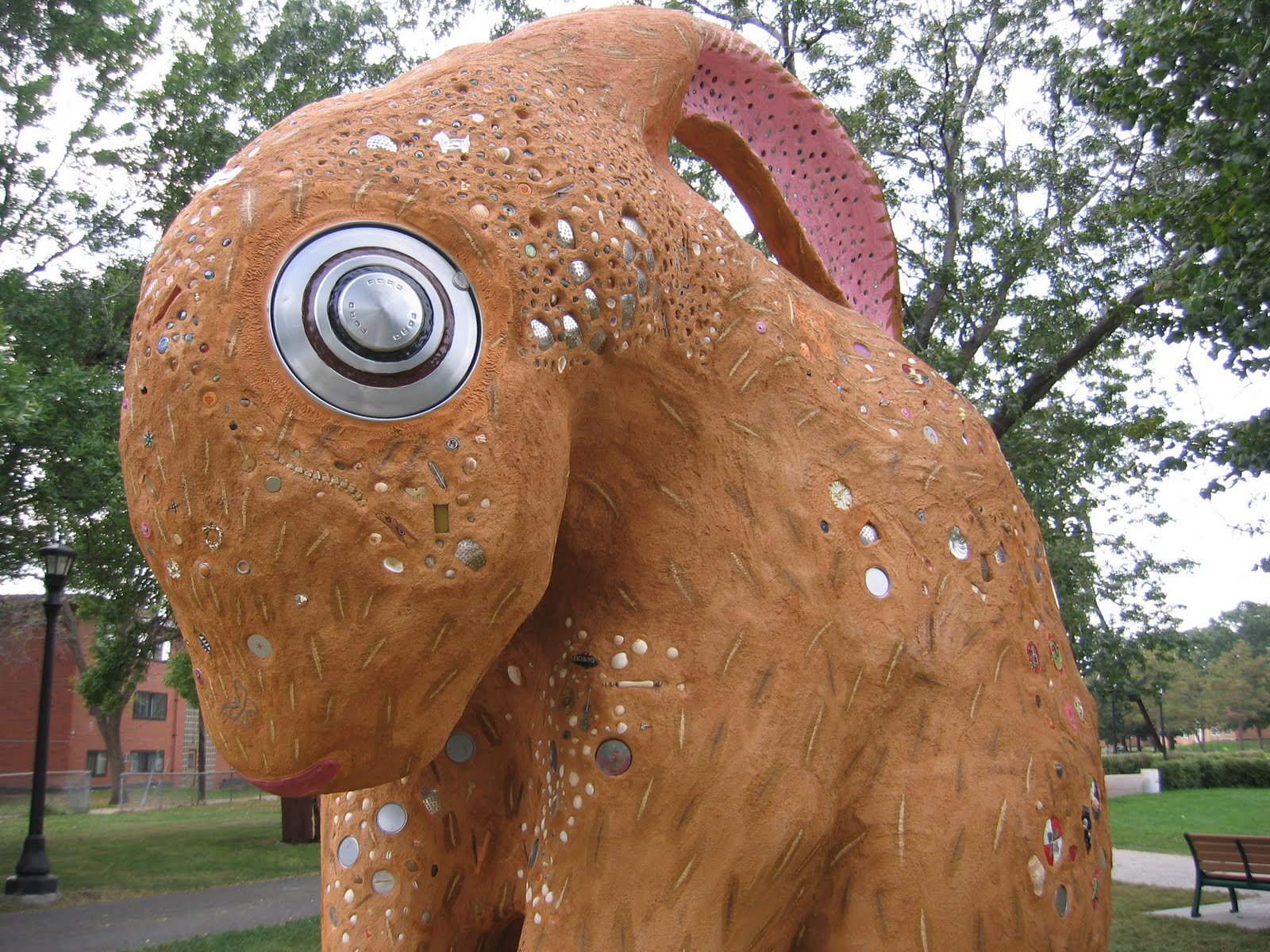
Leporid Sculpture


In creating her 14' Leporid in St. Paul's Western Sculpture Park, artist Mary Johnson used rebar, lath and cement. She also invited children from the neighborhood to help create mosaic medallions from found objects which were then embedded into the leporid's "hide." She used the hub caps from a '58 Ford for the eyes!


Images: The Leveret.

Sunday, May 30, 2010

Morning Light XXXII


Image: Subject and photographer unknown.

Friday, May 28, 2010

Soul of the Sufferer

Write George Ewart Evans and David Thomson:

. . . Belief in the transmigration of souls either into animals or other human beings seems at one time to have been universal. The thought behind it is familiar to us all and comes from observation. A parent can often see his/her dead father or mother not only in the character but in the gestures and facial expressions of his/her child and it is natural for anyone who lives among animals to observe in them traits that belong to people too. They were and sometimes still are, invested with human souls by imaginative sympathy; the lion has the dignity and courage of a noble person, the elephant wisdom and the long memory that goes with it, Swallows are skilled and spiritual. The hare is chosen for qualities as varied as its nature and has the soul of the sufferer, the fecund begetter, creator of arts, inventive dreamer, and, principally, of the person who is gifted with an intuitive leaping mind.

In some societies it was not everybody’s soul that could enter an animal. Only the chosen – the wise elder or the child that was born to be a priest or shaman – possessed that power; they possessed it during their lives as well as after death. Like the witches they could shift their minds into paraphysical states, rendering themselves “beside themselves” as we say of people who have temporarily abandoned the controls of reason.

The [following] ritual rhyme of the Scottish witches . . . describes a psychological transformation that went together with dressing up as a hare. In modern English it means:

I shall go into a hare
With sorrow and sigh
and (probably) mental torment.

– George Ewart Evans and David Thomson
The Leaping Hare
Pp. 148-149

Monday, May 24, 2010

Cock Rock


In his "Salute to the Greatest Crotches in Rock," Morgan Short notes that "the crotches of rock singers have captivated the imagination of the world" for years.

As "an embodiment of the mystery, danger and freedom of the music itself," writes Short, "the crotch has occupied a central role in a stirring rock performance."

Continuing, he notes:

Of course, the crotch today remains a valuable weapon in the rock arsenal, as exemplified by the current wave of tight pants bands rehashing the Kinks/The Who sound of the 60s and 70s. More and more women are also mobilizing their crotches as well for the good of the rock. Take Peaches, for example. In recent years, the famed Electroclash chanteuse has turned her crotch into something of a cottage industry for photos, song lyrics and album covers.

His "salute," however, focuses on "elder statesmen and women of rock; those who burned bright, burned big and then (mostly) wilted away." Yet "whether by physical presentation, stylistic innovation or a certain ineffable spirituality," the crotches of those highlighted "will always live on in the hearts of the fans."

Top of the list is Led Zepplin's Robert Plant, who elsewhere on the web is described as the "Definitive Bulge of Rock and Roll."

"The crotch of Robert Plant," writes Short, "should be considered the fifth instrument of Zeppelin. For stripping away all ambiguity as to the proportions, dimensions and angles of his package, Robert Plant is a true innovator. On stage he may have been singing 'Kashmir,' 'All My Love,' and 'Ramble On,' but implicitly he was whispering gingerly into your ear, 'Here is the outline of my penis.'

Others highlighted in Short's "Salute to the Greatest Crotches in Rock" include Freddie Mercury, Iggy Pop, Bon Scott, Jim Morrison, Axel Rose, Prince, David Bowie, Courtney Love, and David Lee Roth.

To view and read more , click
here.